The buffer question nobody's answered
This isn't about whether the site smells bad. It's about a specific line in the City of Nedlands' own planning scheme, a specific admission in the government's own business-case review, and a specific question that's been asked once in Parliament and never really answered since.
This is a technical page, deliberately. It won't move you the way a photo of a school fence does. That's the point — it's aimed at planners, journalists and parliamentarians as much as neighbours, because a live statutory compliance question is a different kind of pressure on this project than a community objection is. Last built: 14 September 2026.
What the law actually says
The City of Nedlands' Local Planning Scheme No. 3 designates a mapped Special Control Area over the land around the Subiaco Wastewater Treatment Plant — Special Control Area 1, the "Subiaco Strategic Water Resource Precinct." Its stated purpose is "orderly and proper planning" around the plant; one of its objectives is explicitly "to prevent the introduction and intensification of land uses or development which would be incompatible with" the plant's ongoing operation and expansion.
"No residential or other sensitive land uses as defined by EPA Guidance Statement No. 3 (Separation Distances Between Industrial and Sensitive Land Uses, June 2005) are to be located in the Subiaco Waste Water Treatment Plant odour buffer."
Verified directly against the current scheme text (as amended, gazetted to Feb 2026). Source: City of Nedlands LPS 3, cl.36 & Table 7
EPA Guidance Statement No. 3 defines "sensitive land uses" to include residential development, schools, nursing homes, child care — and hospitals, expressly. The same scheme separately requires the local government, before approving any development, scheme amendment, structure plan or local development plan in this precinct, to have regard to Water Corporation and environmental regulator advice on odour impact — and requires a current odour-modelling technical report to confirm the buffer's boundaries wherever one of those planning instruments is involved.
Put plainly: this isn't a guideline a proponent can weigh up and move past with a good enough report. It's a rule that says the use isn't to be located there, sitting inside a scheme that separately spells out exactly what evidence is meant to inform any decision that touches the area.
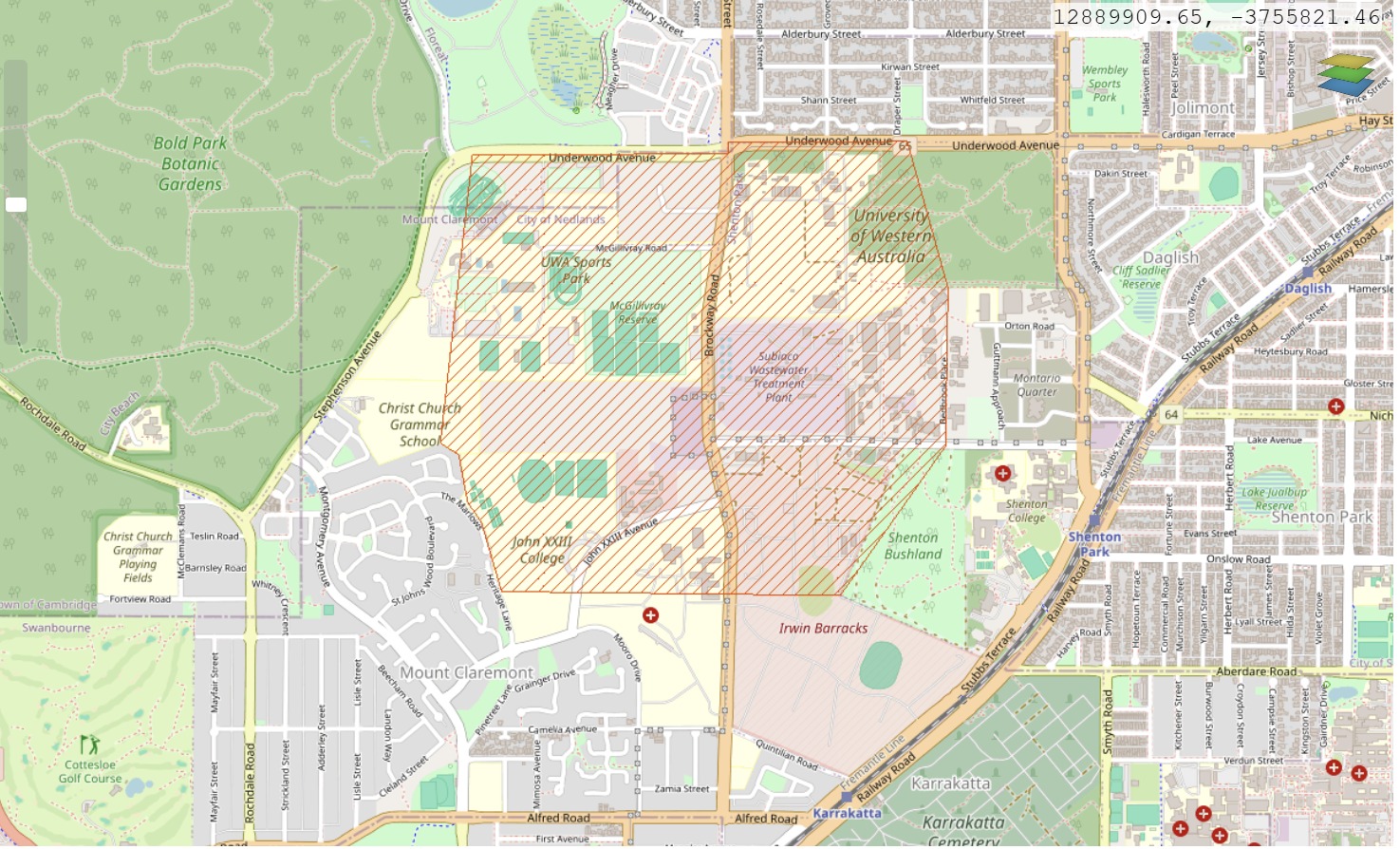
Why "Frankland's already there" doesn't answer this
The obvious response is that a secure forensic unit has operated at Graylands since 1993, and the sky hasn't fallen. That's true, and it's also not really an answer — because the Frankland Centre and the proposed new build sit under two different legal tests.
Frankland Centre, 1993
LPS3 protects "the continued use of any land... for the purpose for which it was being lawfully used immediately before the commencement of this Scheme." Frankland predates SCA1 (gazetted 2019) by 26 years. If it was lawfully established — and the available record suggests it was, under the more permissive planning regime of the time — the modern scheme doesn't retrospectively switch it off. That's an ordinary, unremarkable non-conforming-use protection.
The 2026 forensic campus
The same scheme says a person "must not, without development approval... alter or extend a non-conforming use of land." Grandfathering protects continuation. It doesn't pre-clear intensification. A new, larger, differently-configured forensic campus is a fresh question under SCA1 — not something the 1993 building answers on its behalf.
Source for both: City of Nedlands LPS 3, cl.22 & cl.23
What the government has already admitted
None of this is a theory we've constructed from a zoning map. The government's own paper trail already puts the site inside the buffer and treats that as a live, unresolved problem.
What's missing
Three things the government's own paperwork — or the wider planning framework — says should exist and be checkable don't show up where you'd expect to find them.
The federal environmental referral doesn't mention it
We checked. The State's own EPBC referral for this exact project — the document that walks through heritage, vegetation, black-cockatoo habitat and construction impacts at length — contains zero mentions of "odour" and zero mentions of "wastewater" anywhere in its 48 pages. It discusses the site's "Public Purposes – Hospital" reservation under both the Metropolitan Region Scheme and LPS3, but not LPS3's separate SCA1 restriction on sensitive uses in the buffer.
To be fair to the document: an EPBC referral serves a Commonwealth environmental purpose, not a State planning one, so this isn't necessarily an omission it was required to fix. But it means the referral's claim of being "consistent with the current reservation and zoning status" answers the hospital-reservation question and doesn't touch the odour-buffer question at all.
Verified directly against the referral document (EPBC 2025-10271), not taken on trust from a summary.
The local planning authority says it has received nothing
Asked directly by this community, in writing, whether it had received "any development application, public works referral, WAPC referral, heritage material, traffic assessment, environmental material or other planning document" for this project, the City of Nedlands' answer — dated 17 July 2026 — was:
"No - only the Summary assessment report as attached."
That's a direct quote from the Mayor's own written reply, already published on our Correspondence page. It means that as of that date, none of the documents that would ordinarily carry a buffer/odour assessment through the statutory planning process had reached the authority responsible for assessing exactly that.
A second approval question the local scheme doesn't even reach
Everything above concerns the City of Nedlands' own scheme. A separate, State-level scheme applies to the same reserved land: the Metropolitan Region Scheme (MRS). Under its current provisions — rewritten by Parliament in 2024, in force since 31 March 2025 — a person must not develop reserved land without development approval under the MRS, unless a specific exemption applies (cl.27). The MRS's own exemption list covers things like boundary fences, interior-only works, demolition, certain signage, and public-authority works for water, wastewater, road and rail infrastructure — nothing on the list obviously covers construction of new hospital buildings (cl.29). A further clause lets a public authority use reserved land without MRS approval for the purpose it's reserved for (cl.30) — but that clause is headed "use," not "development," and the Scheme treats the two as separate questions elsewhere in the same Part. Whether it extends to building an entirely new campus, rather than continuing an existing one, isn't something we've seen tested or confirmed publicly.
Separately, the Planning and Development Act 2005 requires that when the Crown or a public authority exercises its public-works powers, it does so "having due regard to" the purpose of the relevant planning scheme and to orderly and proper planning, and that the responsible authority "is to be consulted... at the time when a proposal... is being formulated" (s.6). Carrying out development that requires approval without holding it, or breaching an approval's conditions, is itself an offence under the Act (s.162).
None of this tells us the answer — only that there's a second, independent approval question sitting alongside the odour-buffer one, and nothing published resolves it either way for this project. Metropolitan Region Scheme, cl.27, 29, 30 (current, from 31 Mar 2025) · Planning and Development Act 2005, ss.6, 162
Verified against the current consolidated text of both instruments, not an older or paraphrased version — the MRS provisions above are recent enough (current form since March 2025) that this specific question doesn't appear to have been publicly tested for this project yet.
What we're asking to see
We're not alleging the project is unlawful. We don't have the documents that would let anyone say that either way — which is exactly the problem. These are the specific records that would settle it, one way or the other:
- The sections of the Cabinet-approved Project Definition Plan dealing with the Subiaco WWTP odour buffer, SCA1 and planning approval pathway.
- Any current odour-modelling technical report commissioned for this project.
- Water Corporation's and DWER's formal advice on locating this specific development within the buffer.
- Confirmation of whether a development application has now been lodged with the City of Nedlands / WAPC, and its status.
- Whichever legal mechanism — public-works exemption, buffer reduction, or a standard SCA1 approval pathway — the government considers resolves the SCA1 restriction for this project.
- Whether any Metropolitan Region Scheme development approval — a separate, State-level question from SCA1 — has been sought or granted for the new campus buildings, and if not, which exemption is relied on.
The most decision-relevant question — is the buffer fix funded and on a timeline that lands before Stage 1 needs it — is now FOI Request 9, deliberately narrow so it's harder to wave off the way the July 2025 Estimates question was. If the answer is straightforward, this argument closes in a paragraph. If it isn't, that's the story.
Part of that question no longer needs an FOI answer. Infrastructure WA's own December 2025 assessment of the plant upgrade shows the earliest realistic date for any buffer-capable fix is the early 2030s, and shows the buffer reduction itself has not yet been approved even to investigate. That doesn't close FOI Request 9 — it still asks whether Graylands' own planning proceeds on some other basis, or simply proceeds regardless — but it does mean one possible answer is now off the table: there is no funded, dated buffer fix landing before Stage 1 needs it.
Reducing the buffer would benefit the wider neighbourhood regardless of how the forensic campus decision goes — this isn't a request we're hoping fails.
A statutory planning restriction that hasn't been publicly shown to be resolved is exactly the kind of thing a proper consultation and publication process exists to catch before it becomes irreversible.
Sign the petition