Covering the Graylands Campus Project
A sourced fact sheet and image library for reporting on the Graylands forensic mental health campus expansion in Mount Claremont, Western Australia.
A forensic mental health campus set to nearly double in size — closing every general psychiatric bed on the site in the process — sits within a kilometre of five schools, one of them, John XXIII College, on its direct boundary. Site works began in September 2026. Infrastructure WA, the government's own statutory infrastructure advisor, found the funding case inadequate in March 2023; government committed $218.9 million three weeks later, while its own Budget Papers still described that business case as unfinished. No consultation with residents or nearby schools has been identified across five years of planning — though government ran exactly that process, advertised and dated, the last time forensic capacity grew on this site, in 1993.
What we are not saying
- Not that the project should be cancelled.
- Not that forensic mental health patients are dangerous as a class.
- Not opposed to mental health services at Graylands, which has provided them since 1909.
- Not that harm will occur — the claim is narrower: nobody has published the evidence to show it won't, and a government that overrides its own independent infrastructure advisor carries the burden of showing its work.
The facts
Five schools, a campus about to nearly double, no consultation on the record. John XXIII College shares its boundary with the site; four more schools sit within a kilometre. The campus grows from around 45 forensic beds to 176, and every remaining general psychiatric bed closes. Asked in its September 2026 fact sheet what consultation had occurred, government named clinical experts and lived-experience groups — not residents, not the schools. No formal local consultation appears anywhere in the public record across five years of planning.
The state's own infrastructure adviser found the case inadequate. It was funded three weeks later. In March 2023, Infrastructure WA assessed the business case and found it had "insufficient information on which to base an investment decision." Government committed $218.9 million about three weeks after that finding. Its own Budget Papers record the money as "provisioned" while the Stage 1 business case was still "under development for future Government consideration." No document explaining what had changed has been published.
Government consulted residents before Frankland opened in 1993. Nothing equivalent has happened this time. Before Graylands' first secure forensic unit admitted a patient, the Health Minister publicly promised the community would be consulted on admission guidelines first, then followed through: newspaper advertisements, letters and pamphlets to residents, and a dated deadline for public comment. Thirty-three years later, a change many times larger — the whole site converting to forensic use — has had no equivalent process identified. Longer account, sources and photographs: the history page.
The site sits inside a sewage-treatment odour buffer the council's own rules say should exclude it. The City of Nedlands' planning scheme excludes "sensitive land uses," hospitals included, from the mapped buffer around the Subiaco Wastewater Treatment Plant. Asked in Parliament in 2025 whether a risk assessment had been done, the responsible Minister's full answer was one sentence, with no modelling or conclusion volunteered. Full record, including the planning clause and the Hansard exchange: the odour buffer page.
Also on the record: WA's own psychiatrists describe the state's forensic mental health system as "gridlocked," and in April 2026 the Supreme Court found it "impossible" to properly apply the state's mental impairment law because there's no secure hospital capacity — a man found not criminally responsible for a killing is being held in prison indefinitely as a result ABC News, 27 Apr 2026. This campaign does not dispute that WA needs more forensic capacity; its position is that concentrating it at this site, at this scale, hasn't been shown to be the right way to provide it.
Background: how the site has changed
Fuller history, with 1980s–90s detail, maps and photographs: the history page.
Sourced fact sheet
- Infrastructure WA found the business case had "insufficient information on which to base an investment decision"; government funded it roughly three weeks later, while its own Budget Papers described the business case as still "under development" Infrastructure WA, Mar 2023
- Project spending rises from $3.6M (2025–26) to $107.5M across the following two years, per the government's own budget papers WA Budget Papers, Asset Investment Program, 2026–27
- ADCO Constructions engaged 9 April 2026 for Early Contractor Involvement; the same announcement confirms $10.6M allocated to relocate the Claremont Therapeutic Riding Centre to 9 John XXIII Avenue WA Government media statement, 9 Apr 2026
- Asked in Parliament whether heritage and odour-buffer risk had been assessed, the Minister answered "yes... as part of the project definition plan" with no further detail — the fullest official account of the PDP's contents on the public record Hansard, LA Estimates, 3 Jul 2025
- Site chosen in 2021 from 20 candidates on accessibility and transport criteria only — not security or school proximity Infrastructure WA, Mar 2023
- The Criminal Law (Mental Impairment) Act 2023 replaced indefinite detention with fixed limiting terms and expanded leave and reintegration mechanisms — commenced 1 September 2024 WA Legislation
- In April 2026, the Supreme Court found it "impossible" to fully apply the CLMI Act because of the lack of secure hospital beds; WA's forensic hospital has held at 30 beds while the prison population more than quadrupled ABC News, 27 Apr 2026
- Taskforce (GRAFT) dissolved July 2023; no community, school or local government representation confirmed at any stage Campaign timeline
- City of Nedlands has confirmed in writing it received no development application, referral or environmental material as at 17 July 2026 Correspondence page
- The site sits within the Subiaco Wastewater Treatment Plant odour buffer, where the City of Nedlands' own planning scheme restricts sensitive land uses including hospitals The odour buffer page
- Infrastructure WA's own December 2025 assessment of the wastewater plant upgrade that could reduce this buffer puts commissioning at "the early 2030s" at the earliest, and treats the buffer reduction itself as a separate step not yet approved even to investigate Infrastructure WA, Dec 2025
- Current Stage 1 is funded at $197.4M; the long-term plan Infrastructure WA assessed — 136 forensic beds plus 40 secure rehabilitation beds — was costed at ~$698M, of which only Stage 1 is currently funded Infrastructure WA, Mar 2023
- When Frankland opened, government advertised for public submissions on admission guidelines, wrote to and letterboxed residents, and set a dated comment deadline — a real, run precedent for consultation at this exact site WA Government media statement, 10 Oct 1993
- WA's psychiatrists describe the state's forensic mental health system as "gridlocked" and say the Graylands redevelopment alone "will not deliver" enough beds for future need RANZCP WA, Jul 2026
- OMID's project team leads delivery "in consultation with" Health and NMHS — a construction-delivery mandate, not the taskforce GRAFT once was Tender OMID2026071, May 2026
Full sourcing for every figure above is in the Community Research Paper and the Sources page.
Assets
Images already used across the site, gathered here so you don't have to hunt page by page. Click any image to view full size; right-click to save. Provenance is under each one — the images we made ourselves are free to use with credit; images sourced from government documents are marked accordingly and are not ours to license.
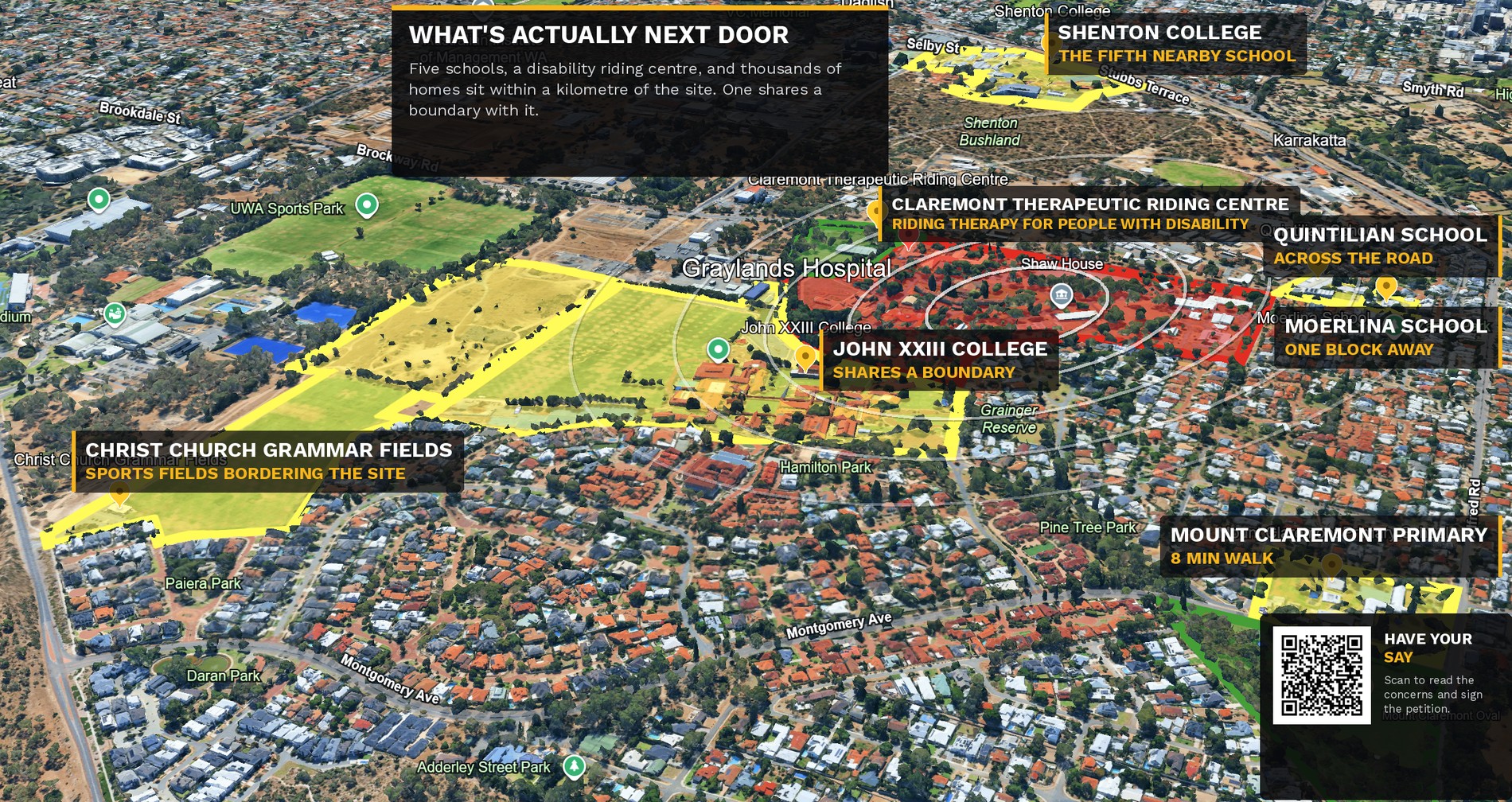
The site and its neighbours
Annotated aerial — Graylands campus with John XXIII College, Quintilian, Moerlina, Mount Claremont Primary and the CTRC marked. The single most useful image for establishing context in ten seconds.
Base aerial imagery with our own annotation, free to use with credit. The base imagery itself is not ours — ask if you need its original source confirmed for your own clearance.
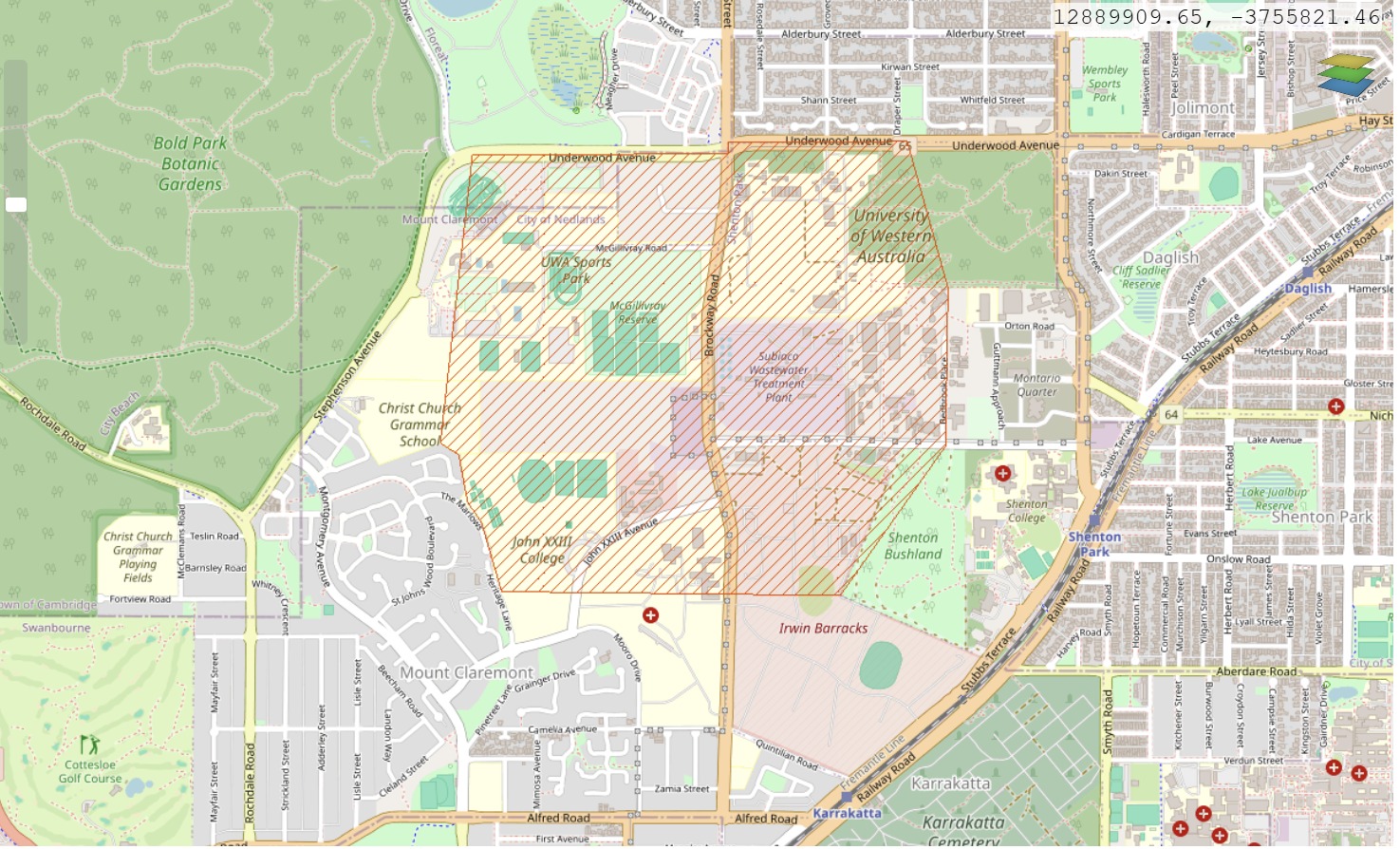
The mapped odour buffer
Water Corporation's own Buffer Areas dataset (WCORP-088) — the Graylands site sits inside the hatched zone.
Published on data.wa.gov.au under Creative Commons Attribution — freely reusable with credit to Water Corporation. Basemap © OpenStreetMap contributors.
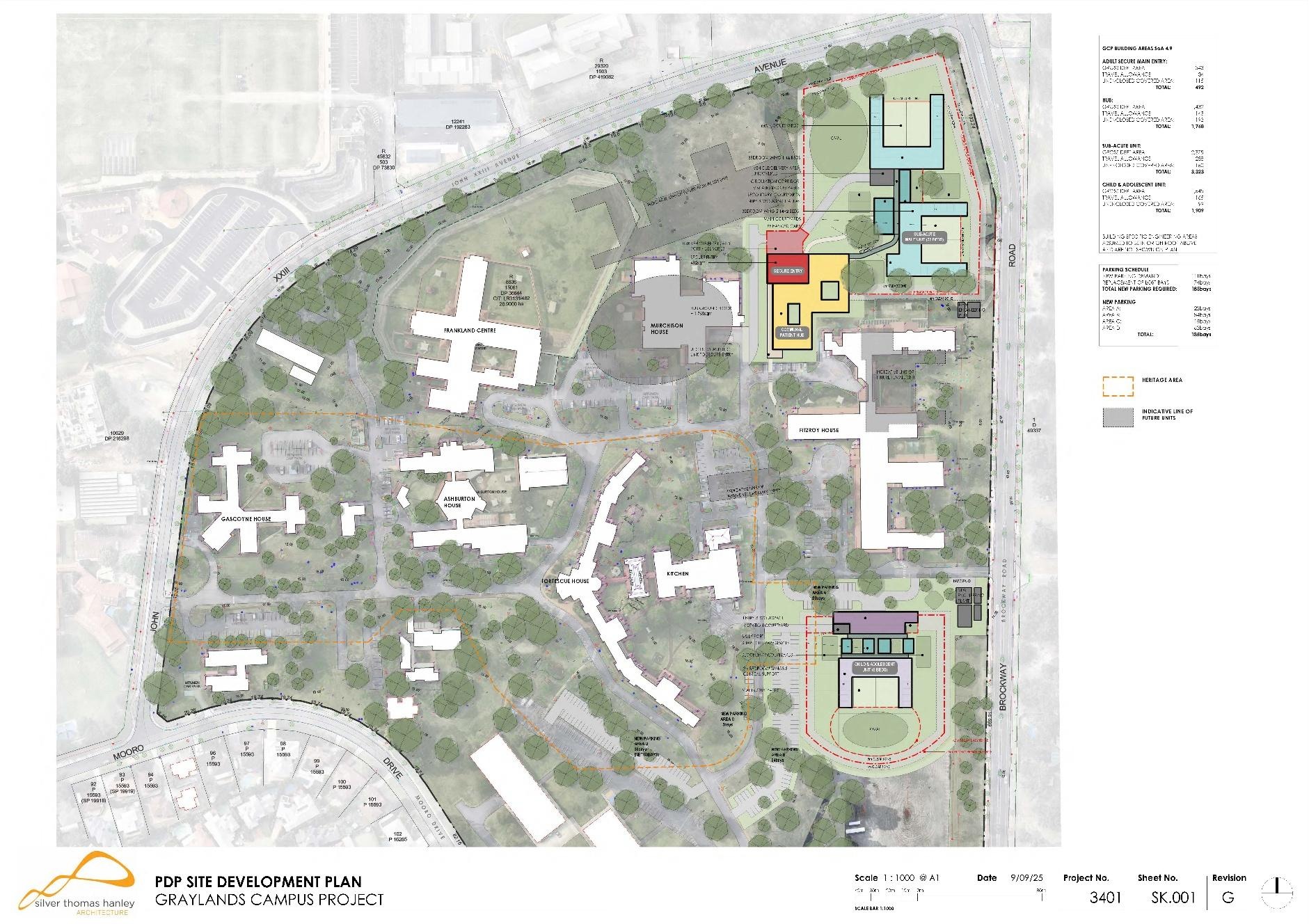
Stage 1 site development plan
The State's own drawing for what's actually funded and being built now — Silver Thomas Hanley Architecture, SK.001 Rev G, 9 September 2025.
Government document, extracted from the public tender (EOI, Schedule 2) — not ours; credit the source document.
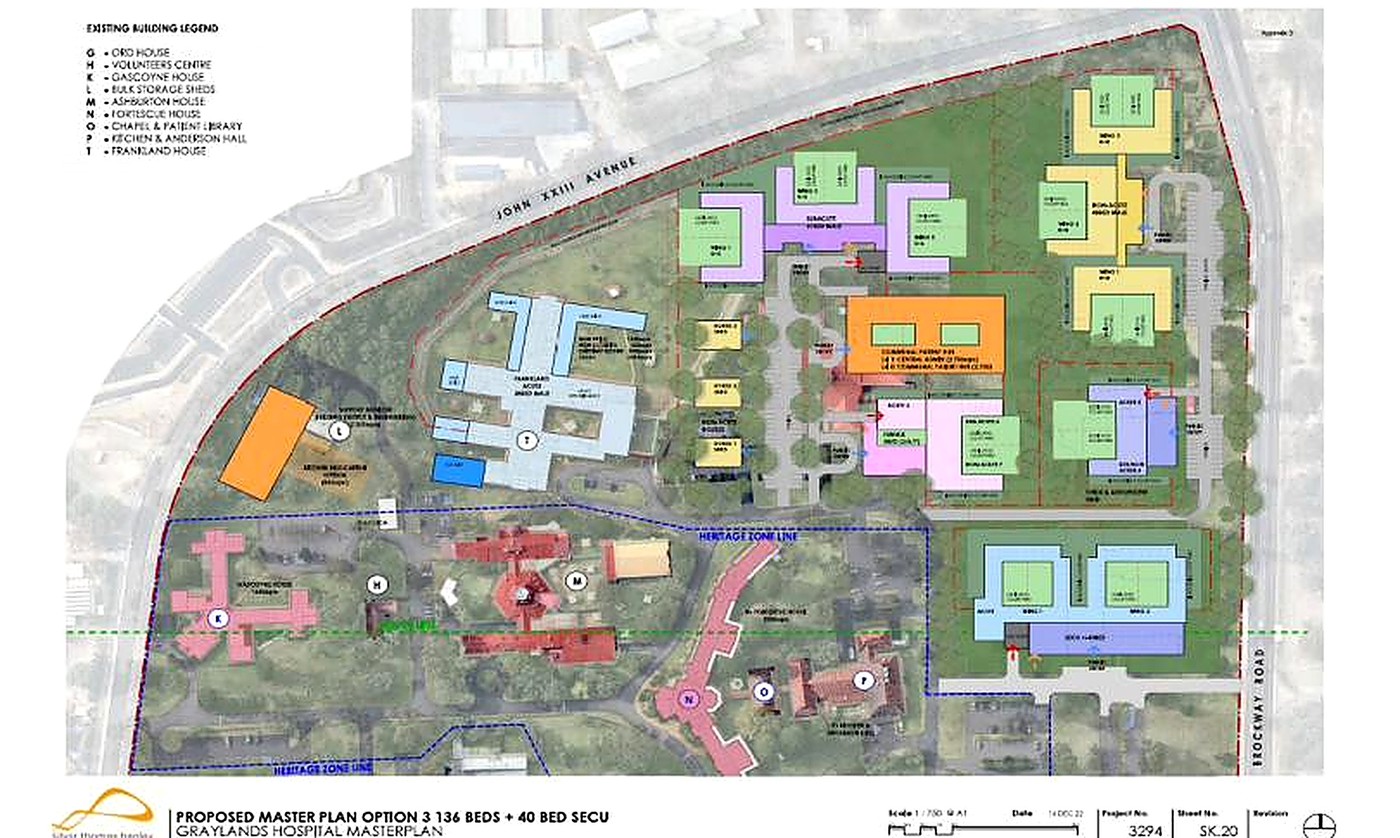
The full long-term plan — 176 beds
The masterplan option Infrastructure WA actually assessed in March 2023 — the clearest single image of what the full plan looks like beyond the currently-funded Stage 1 slice.
Government document, from Infrastructure WA's published report — not ours; credit the source.
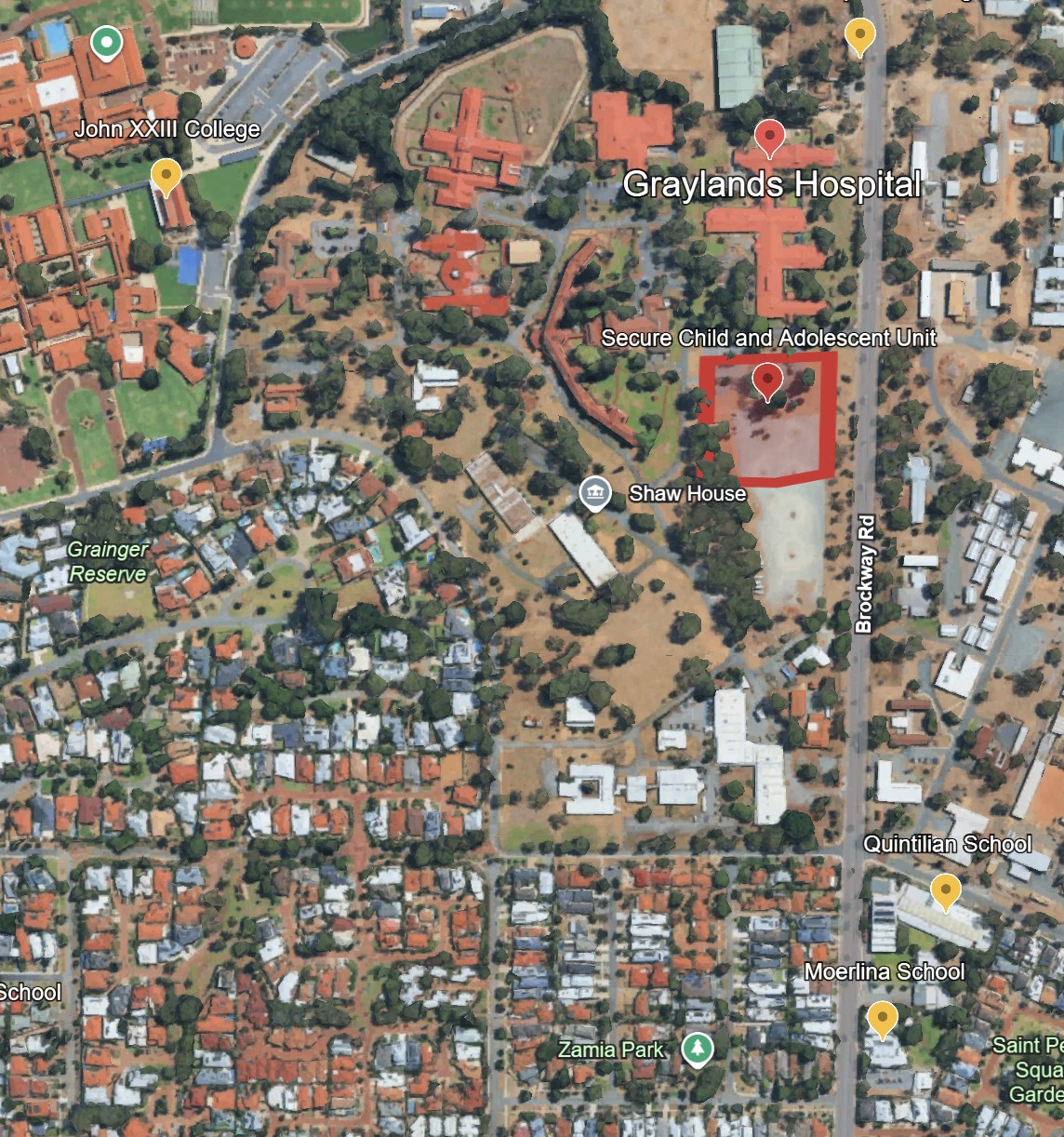
Distance to Quintilian School
The secure Child and Adolescent Unit's own fenced perimeter sits roughly 400 metres from Quintilian School.
Our own annotation over satellite imagery and the tender site plans — free to use, credit Mount Claremont Community Network.
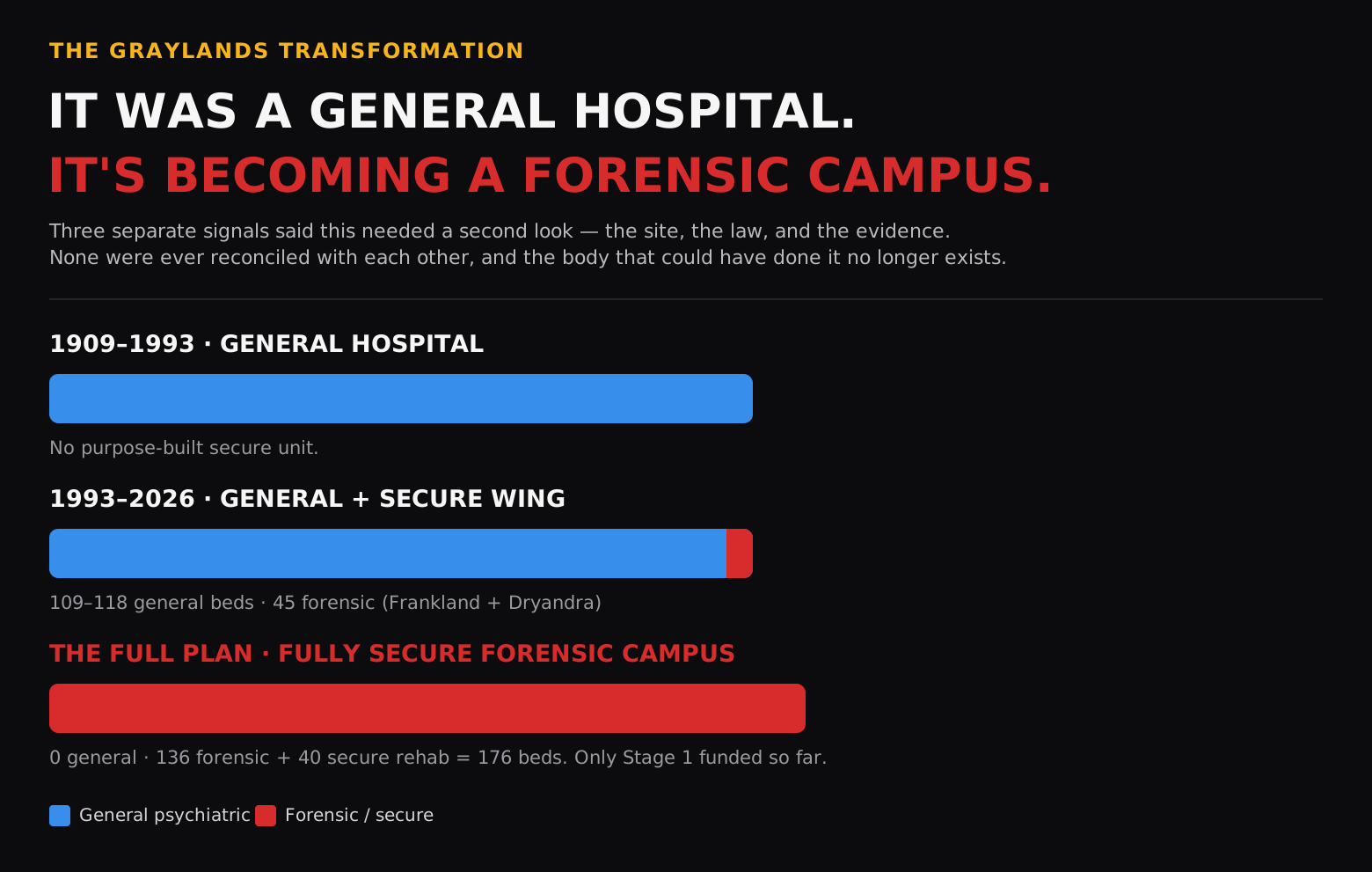
"Same site, new model" timeline
1909 general hospital → 1993 small secure wing added → 2026 fully forensic campus, in one graphic.
Ours — free to use, credit Mount Claremont Community Network. Vector SVG, scales cleanly to any size.
More plans and diagrams — including the CTRC relocation aerial and concept masterplan, the existing site plan, and the full buffer-map background — are on The site and the odour buffer page. A 1991 photograph of the community campaign that led to the 1993 consultation, and other historical images, appear on the history page — those come from a 2013 university thesis and earlier newspaper sources; we don't hold rights to them and can't authorise their use, but they're there to view and verify, and the thesis itself is linked in full. Ask if you need something specific redrawn, a higher-resolution crop, or the base files for anything above.
Contact
Media enquiries: mtclaremontcommunity@gmail.com. A resident spokesperson — previously quoted in WAtoday and The Post — is available for interview. If we get something wrong, we correct it; see Updates for the record.