Will Mount Claremont still feel safe?
A forensic mental health campus is tripling in size in a residential neighbourhood, next to five schools. No safety plan for this location has ever been published — and Graylands' own record shows why that matters.
- It will become WA's only large-scale forensic mental health campus — people held on court orders for offences including homicide and child sexual offences, some on a supervised path to community leave.
- Across the whole hospital, Graylands recorded 153 absconding events in the one year a full breakdown was ever published — seven times the next-highest WA hospital.
- The site was chosen on transport access alone in 2021; the law governing what patients can do changed in 2023, after the site was already locked in. Nobody has published anything showing it was checked against the new model.
- No formal consultation with residents or schools has been found in the public record.
Not just "more of the same." Graylands has been a hospital since 1909 — that's not what's changing. A small secure wing was added in 1993. What's proposed now closes general psychiatric care entirely and converts the whole site into a 176-bed forensic-only campus, operating under a 2023 law that expands the legal pathway toward supervised, and in some cases unsupervised, community leave. That's not the building that's been part of the neighbourhood for a century, in an area with roughly 2,000 homes and around 4,800 students within a kilometre — and no published assessment shows whether the new one belongs here.
See exactly what's changed, with full sources →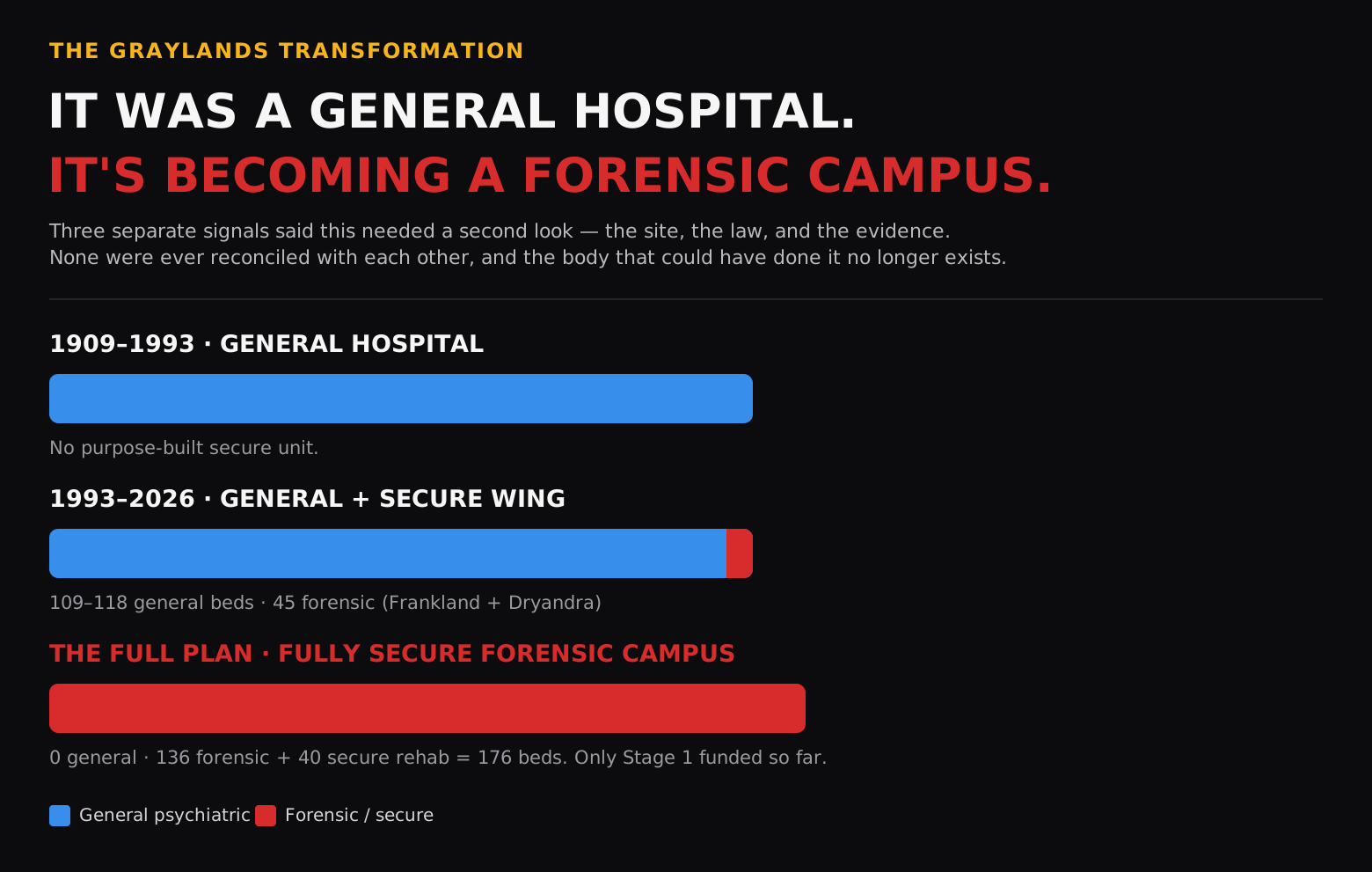
What does "forensic mental health" actually mean?
It means secure detention combined with psychiatric treatment — not an ordinary hospital admission. Patients are held under court orders, having been accused of, convicted of, or found not criminally responsible for serious offences. The presence of mental illness doesn't remove the offending history; it's the reason a court placed them here instead of prison. Under the plan, patients on a lower security tier take part in supervised, then unsupervised, community leave — walking the same streets as everyone else in the neighbourhood.
How the decision was made
The site was chosen in 2021 on transport and access — security and school proximity were not among the criteria. In 2023 the law changed, adding a staged path to supervised community access, after the site was already locked in. The government's own reviewer called the business case inadequate; it was funded three weeks later. The taskforce that could have re-tested the site against the new model dissolved that July. The question that matters most — whether this model is safe in this location — has no published assessment behind it. We can't prove it isn't safe. The government hasn't shown it is.
The site
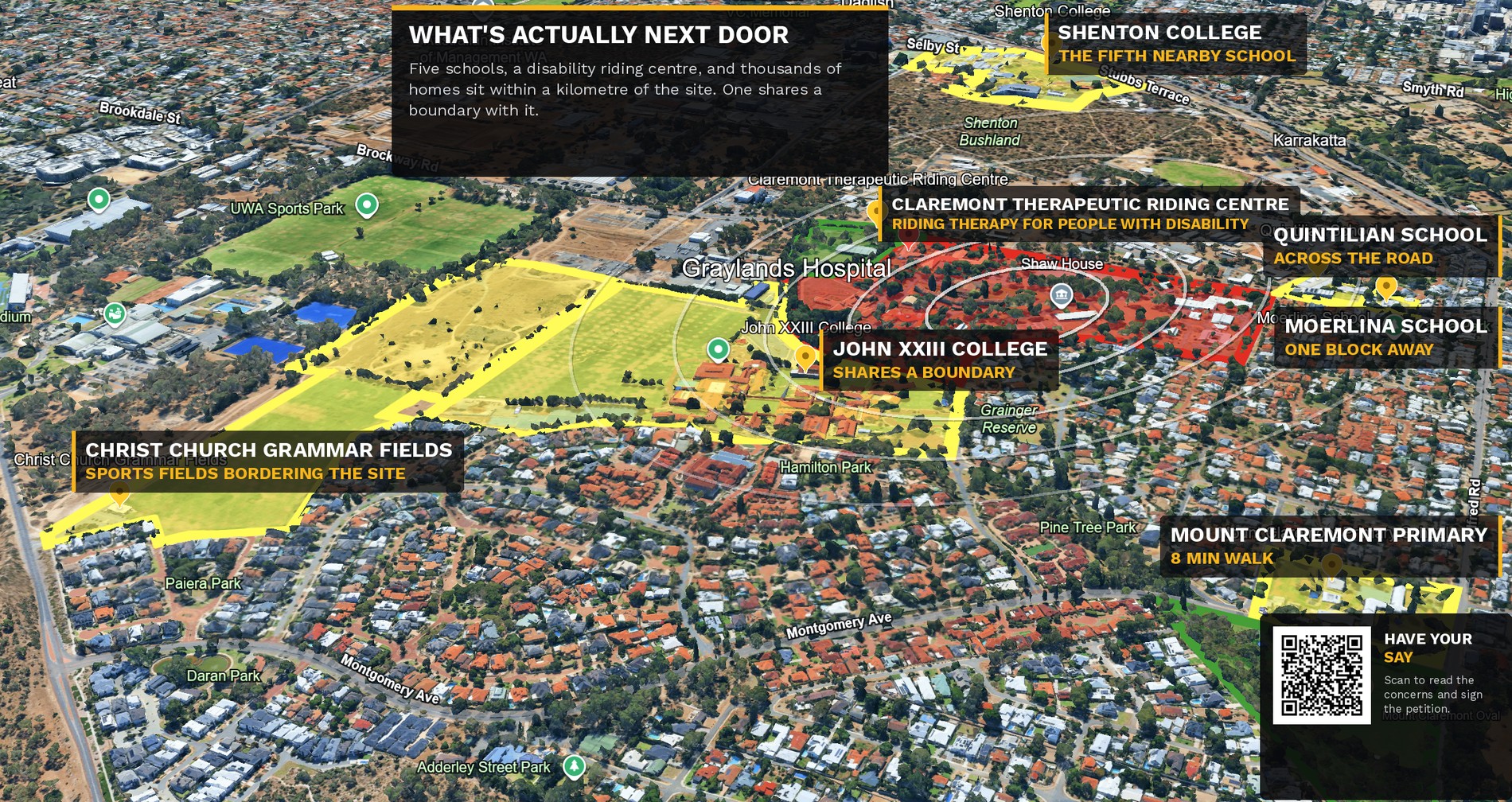
John XXIII College shares a boundary with the proposed expansion. Quintilian School is across the road. The Claremont Therapeutic Riding Centre — which provides riding therapy for people with disability — sits directly against it. Stage 1 alone takes forensic beds from about 45 to about 85; the full plan is 136 forensic beds and 40 recovery beds, a $698.3 million commitment. No formal public consultation with residents or schools has been identified in the public record.
This already happened once. We know exactly how it ends.
In 1990, a 646-signature petition and a detailed speech to the WA Legislative Assembly warned government that this exact plan would produce the exact failures now on the public record: written assurances to this neighbourhood broken, no buffer between the facility and its neighbours, and absconding patients causing serious harm off-site. The MP who gave that speech, Colin Barnett, went on to serve as Premier of Western Australia from 2008 to 2017. Government built neither the buffer nor the isolation he asked for. The failures he told Parliament were inevitable happened anyway — in 2004, 2010, 2012, twice in 2014, and 2015. This isn't a loose parallel. It's a near-exact replica, on the parliamentary record, and this time nobody can say they weren't told.
Latest updates
See all updates →Letters sent, replies received, campaign milestones — the short version, so returning visitors don't have to re-read the whole site to see what's new.
Loading updates…
Eight documented concerns
Each one is drawn from a government document, a parliamentary record, or credible reporting — not from speculation. Tap a card for the short version, or jump straight to the full sourced case.
If these eight concerns trouble you as much as they trouble us, here's where that goes.
Every claim is checkable
Wherever you see a small tag like this — Infrastructure WA, Mar 2023 — it marks a claim drawn directly from a named, publicly available source: a government report, Hansard, or credible media. The full list is on the Sources page, and every source is independently verifiable.